SLAC Celebrates Femtosecond Week
Join us for five days of ultrafast science from April 17 to 21.
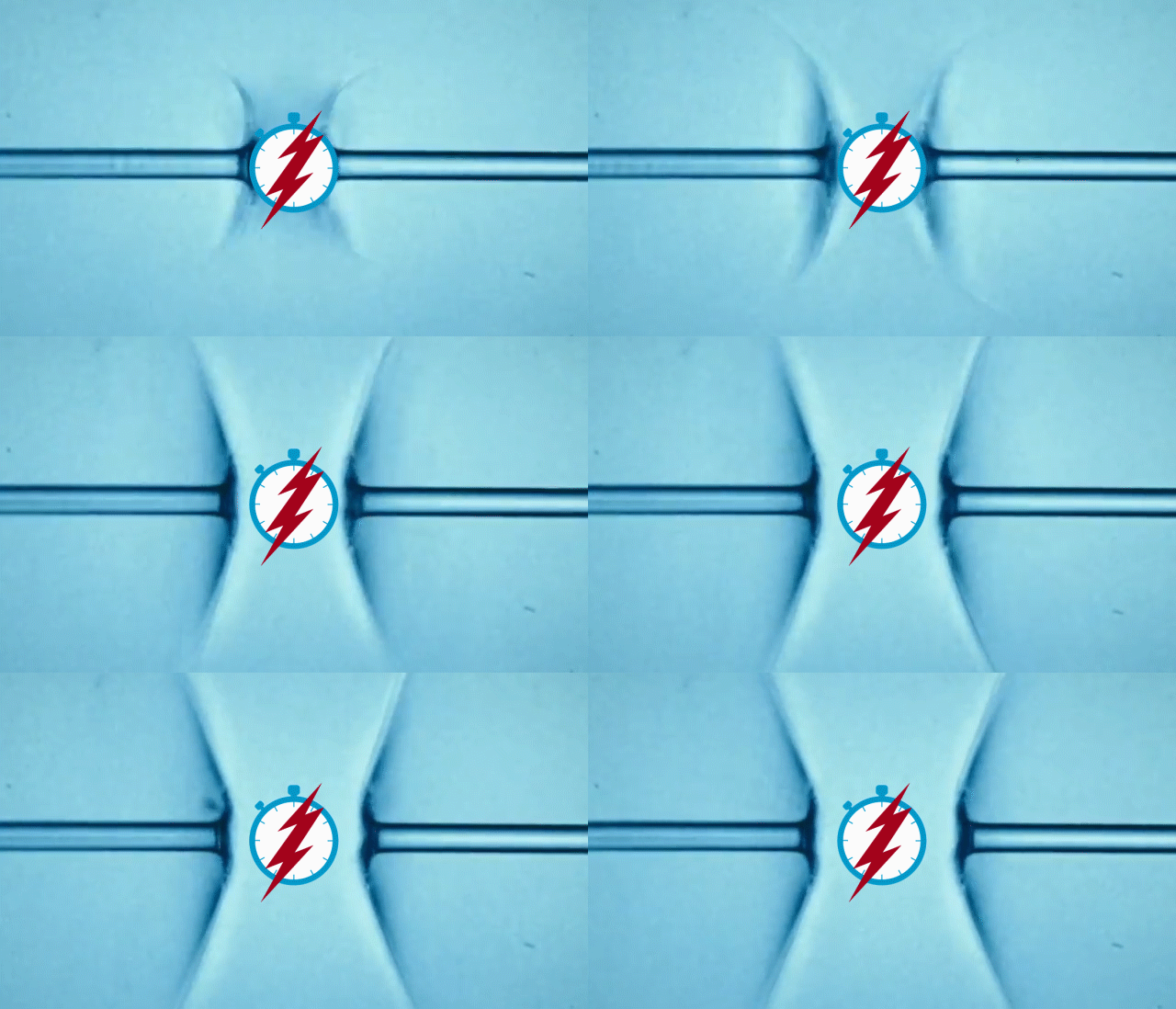
Got a millionth of a billionth of a second? There’s science that actually happens on this timescale.
Join us online for a week of ultrafast science from April 17 to 21. Learn more about how scientists and engineers use electron beams and bright pulses of light from the Linac Coherent Light Source X-ray laser and other advanced lasers to capture some of nature’s speediest processes that occur in just femtoseconds, or quadrillionths of a second.
Join the conversation on social media with #femtoweek.
Monday
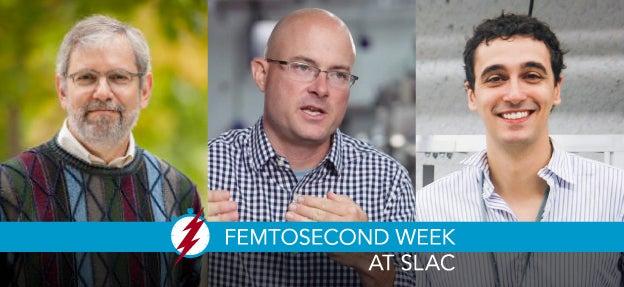
- Physicist Phil Bucksbaum, director of the PULSE Institute at Stanford University and SLAC, gives a brief introduction to why we study on a femtosecond timescale.
- In a video interview, Ryan Coffee, scientist at the Linac Coherent Light Source, explains, “What is a femtosecond?”
- Accelerator physicist Agostino Marinelli discusses how we make femtosecond light.
Tuesday
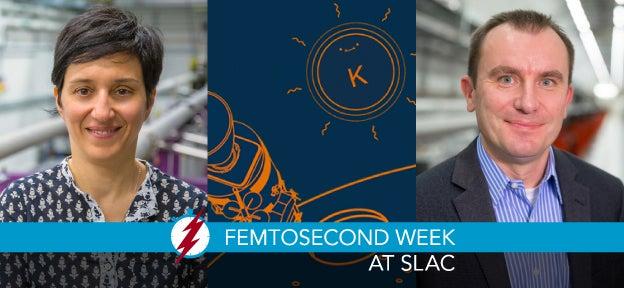
- Learn how we capture femtosecond light with detectors from Gabriella Carini, scientist at the Linac Coherent Light Source.
- Explore the fourth dimension, from processes that occur in billions of years down to tiny slivers of a second.
- Find answers to your burning questions about ultrafast X-ray science. Mike Dunne, director of the Linac Coherent Light Source—the world’s first hard X-ray free-electron laser—will join us for a Twitter chat. Find us at #femtoweek @slaclab.
Wednesday
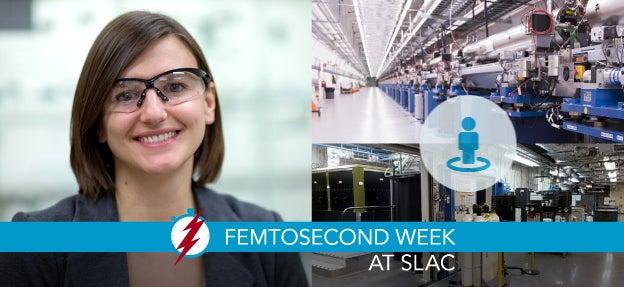
- What can you study in femtoseconds? PULSE scientist Amy Cordones-Hahn describes her work on chemical reactions that turn sunlight into useable energy.
- Take a virtual tour of the undulators and near experimental hall at the Linac Coherent Light Source.
Thursday
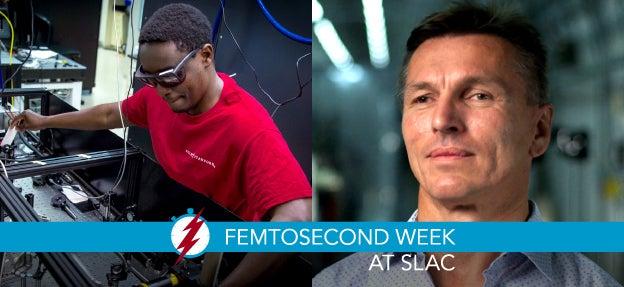
- Read about how SLAC professor Siegfried Glenzer creates extreme conditions like those in the cores of planets and studies nuclear fusion.
- Our ultrafast science factsheet gives an overview of the femtosecond world.
Friday
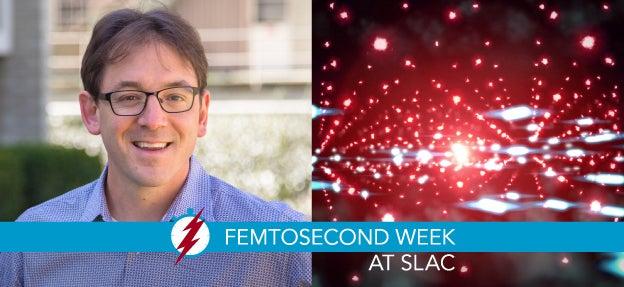
- What else can you study in femtoseconds? Aaron Lindenberg, associate professor at Stanford and SLAC, talks about how he combines X-ray and electron techniques to understand and engineer novel materials.
- And, what’s faster than a femtosecond? Researchers at SLAC are already looking at the largely unexplored realm of attosecond science.

-Written by Amanda Solliday
For questions or comments, contact the SLAC Office of Communications at communications@slac.stanford.edu.
SLAC is a multi-program laboratory exploring frontier questions in photon science, astrophysics, particle physics and accelerator research. Located in Menlo Park, California, SLAC is operated by Stanford University for the U.S. Department of Energy Office of Science. To learn more, please visit www.slac.stanford.edu.
LCLS is a DOE Office of Science User Facility.
SLAC National Accelerator Laboratory is supported by the Office of Science of the U.S. Department of Energy. The Office of Science is the single largest supporter of basic research in the physical sciences in the United States, and is working to address some of the most pressing challenges of our time. For more information, please visit science.energy.gov.
Related stories